After Twenty-Five Years Of Writing For Film, Television, And Streaming, Lyricist Vaibhav Modi Goes Back To The Ghazal With Teri Adaa.
After Twenty-Five Years Of Writing For Film, Television, And Streaming, Lyricist Vaibhav Modi Goes Back To The Ghazal With Teri Adaa.

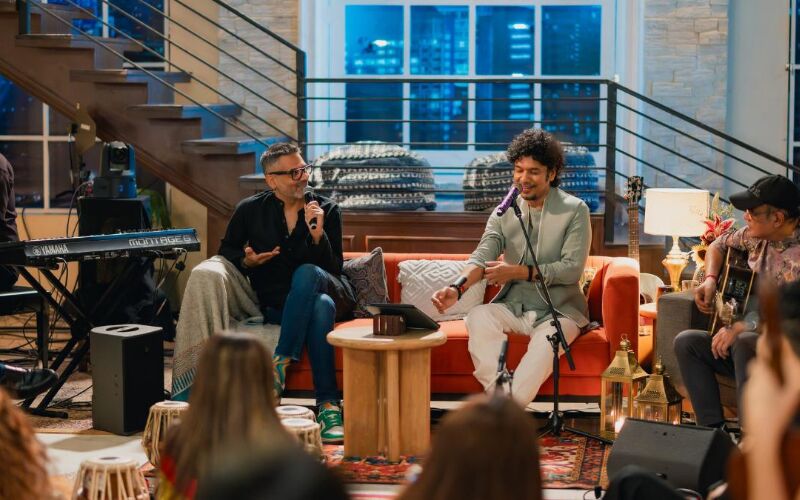
Lyricist Vaibhav Modi in conversation with Papon at the intimate living
room mehfil for Teri Adaa, the first ghazal from the Sar-e-Shaam sessions
In an exclusive conversation with SpotboyE, lyricist, poet
and storyteller Vaibhav Modi opens up about Teri Adaa,
the first ghazal from Sar-e-Shaam, and what it means to return
to the form where he began.
Over more than two decades, Vaibhav Modi has written across films,
television, and streaming, creating and writing shows such as Times of
Music and Mukhbir: The Story of a Spy, and adapting
global formats including MasterChef and Survivor
for Indian audiences. Through all of it, the poet never stopped writing.
Q1. Teri Adaa began with a chance conversation in an elevator with
Papon more than a decade ago. Take us back to that first meeting and how it
turned into Sar-e-Shaam.
Some partnerships are made in studios. Ours was made in an elevator. It was
2012, and I was at a recording for a song I had written for a friend's
telefilm. Papon and I happened to be leaving at the same time, and the
conversation that began in that lift carried on long enough for us to exchange
numbers. What followed was not a plan; it was a habit. We began jamming, and
out of that came Khumaar and Tauba for his Coke Studio India
episode in 2013. Over the years, we became neighbours; we kept creating right
through the lockdown, and somewhere in the middle of all those evenings, the
idea of an album of ghazals took shape. Papon has emerged as an important voice
on the ghazal scene, and it felt like the right time for Sar-e-Shaam
to come out.
Q2. Ghazals are where you began as a poet, long before the screen
found you. What does it mean to step back into the form after twenty-five years
of writing for film, television and streaming?
Honestly, it feels less like stepping back and more like being found out.
Poetry found me long before screenwriting and producing did. I grew up in a
small town in Rajasthan with parents who worked with All India Radio, so there
was always music, and there were always books, and I have read and written
ghazals since my formative years. Everything that came later- the shows, the
formats, the series- happened around that, not instead of it. The ghazal was
even present inside my screen work. I wrote Humse Toh Woh Behtar
and Dil Behel Jaaye for Mukhbir: The Story of a Spy.
This is simply the part of me that was always writing, finally standing in
front of the rest of the work rather than behind it.
Q3. Teri Adaa deliberately walks away from the ghazal's familiar
landscape of heartbreak and lament and chooses playfulness instead. Why did the
form need that shift, and how difficult is it to write mischief into a
classical structure?
Because love is not only sorrow, and the ghazal has always known that. With Teri
Adaa, Papon and I wanted to capture the mischief between two people
instead. The teasing, the little battles of wit, the beautiful unpredictability
of the beloved. As for difficulty, playfulness is genuinely harder to write
than grief. Sorrow forgives a heavy hand; wit does not. In a couplet you have
two lines to set something up and turn it, and if the turn arrives a syllable
late, the magic dies. Another reason to give playfulness a shot was to make it
appealing to a younger audience.
Q4. The album has been six to seven years in the making, shaped over
countless evenings of jamming. What changed in Teri Adaa across those years,
and what survived from the very first draft?
What survived is the beauty of contradiction. From the first evening, we
knew we wanted to play on the conflicting signals between lovers, and what
changed was how much we wanted to bring it back to classic love. One of the
couplets that we did not use in the ghazal goes:
“Waise toh maine pehle bhi chup chup saussko dekha hai… woh dooriyaan
kucch aur thhi, yeh faasla kucch aur hai.”
We decided not to keep it because while everything is technically in the
realm of a classic ghazal, it does not quite carry the attitude we wanted Teri
Adaa to have.
Q5. Your earlier songs for Papon, Khumaar and Tauba from Coke Studio
still live in people's playlists more than a decade later. How did that history
shape the trust between the two of you on this track?
That history is the whole foundation. Khumaar and Tauba
worked the way they did because a lot of elements aligned beautifully, almost
as though the songs had been designed before we got to the first word and the
first note. There was a certain surrender between the poem and the melody, and
between the artists too. Papon has been one of my important influences as well
as a collaborator. He engages with poetry the way a poet does, and invites me
to engage with music the way a musician would. The bedrock of this
collaboration is a confidence that when it feels right to both of us, it
creates a tug at the heart of the listener.
Q6. The song is staged as an intimate living room mehfil. Why was
that format important to you both, and what does a mehfil give a ghazal that a
polished studio video cannot?
A mehfil gives the ghazal two things a polished studio cannot. First, room
to breathe. Every note is allowed its own time and nobody is rushing to a hook.
Second, proximity. In a mehfil, you can see the listener react to a couplet in
real time, and the singer responds to that reaction. The song becomes a
conversation rather than a broadcast. Teri Adaa was staged as
an intimate living room mehfil, with close friends from music, art, films and
publishing, for precisely that reason. Shweta Mishra Mahanta,
Papon's better half and a great friend to us, designed and produced the evening
with a warmth that can only happen in a living room filled with people you
love.
Q7. Do you remember the first time you heard Papon sing these words?
Did it match the ghazal you had been carrying in your head?
Unlike most of my ghazals, Teri Adaa did not come to me on
its own. It happened because Papon wanted it. A late-night session and some
jamming around a particular feel brought the words to me. A rough melody
already existed with its own temperament, and I chose the whole idea of
mischievous contradictions.
Q8. A young audience is discovering Urdu poetry all over again. What
would you say to a listener meeting the ghazal for the first time through Teri
Adaa?
The old wisdom about a good couplet is to capture a unique emotion with such
simplicity that the listener feels, I could have said that. My word to the
younger generation meeting the ghazal through Teri Adaa would
be to find themselves in the poem and let the melody wash over them. That is
the beauty of a ghazal. It makes you feel as if a piece of your existence has
been plucked out and set to a tune. On a literal level, the ghazal is a format
that comes with rules but is the most adaptable form of poetry. It dances
equally well with a semi-classical melody and a modern arrangement. Teri
Adaa could be a great initiation for those who have not engaged with
this form of music and poetry. Our attempt through Sar-e-Shaam
is simply to make that doorway easier to find, and never to gatekeep it.
Q9. Sar-e-Shaam has more ghazals waiting. Without giving too much
away, what should listeners expect as this chapter unfolds?
Two more ghazals from Sar-e-Shaam are set to release in the
months ahead, so Teri Adaa is only the opening of the mehfil. I
would rather let them arrive on their own terms than describe them in advance,
but I can say this much. They come from the same set of evenings and the same
intent, to keep the form intact while widening what it is allowed to feel.
Beyond that, I am writing. I always am. The rest can wait until there is
something real to share.
About Vaibhav Modi
Vaibhav Modi is a Mumbai-based lyricist, poet and storyteller whose words
have travelled across film, television, streaming and independent music for
over twenty-five years.
He grew up in the small towns of Rajasthan, in Kota, Bikaner, Udaipur and
Jaipur, where his parents served as executives with All India Radio, giving him
a childhood spent among record libraries, books and LPs. He taught himself the
Indian bamboo flute as a boy, and music led him to poetry. An environmental
science graduate with an MBA from KJ Somaiya Institute of Management, he moved
to Mumbai in 1999.
He has created and written shows including Times of Music
and Mukhbir: The Story of a Spy, and played pivotal roles in
bringing international formats such as MasterChef, Survivor, Wipeout,
and Deal or No Deal to Indian television. As a lyricist, his songs
span films including Bhopal: A Prayer for Rain, Axone and Drona,
series such as Tripling and Fisaddi, and the Coke Studio India
classics Khumaar and Tauba.
His work has been recognised with a Screenwriters Association Award
in 2023, a Filmfare OTT Award in 2020 and an Asia Academy Creative Award in
Singapore in 2020.
Image Source - google
- Trending


_2026-10-6-11-19-8_small.jpg)